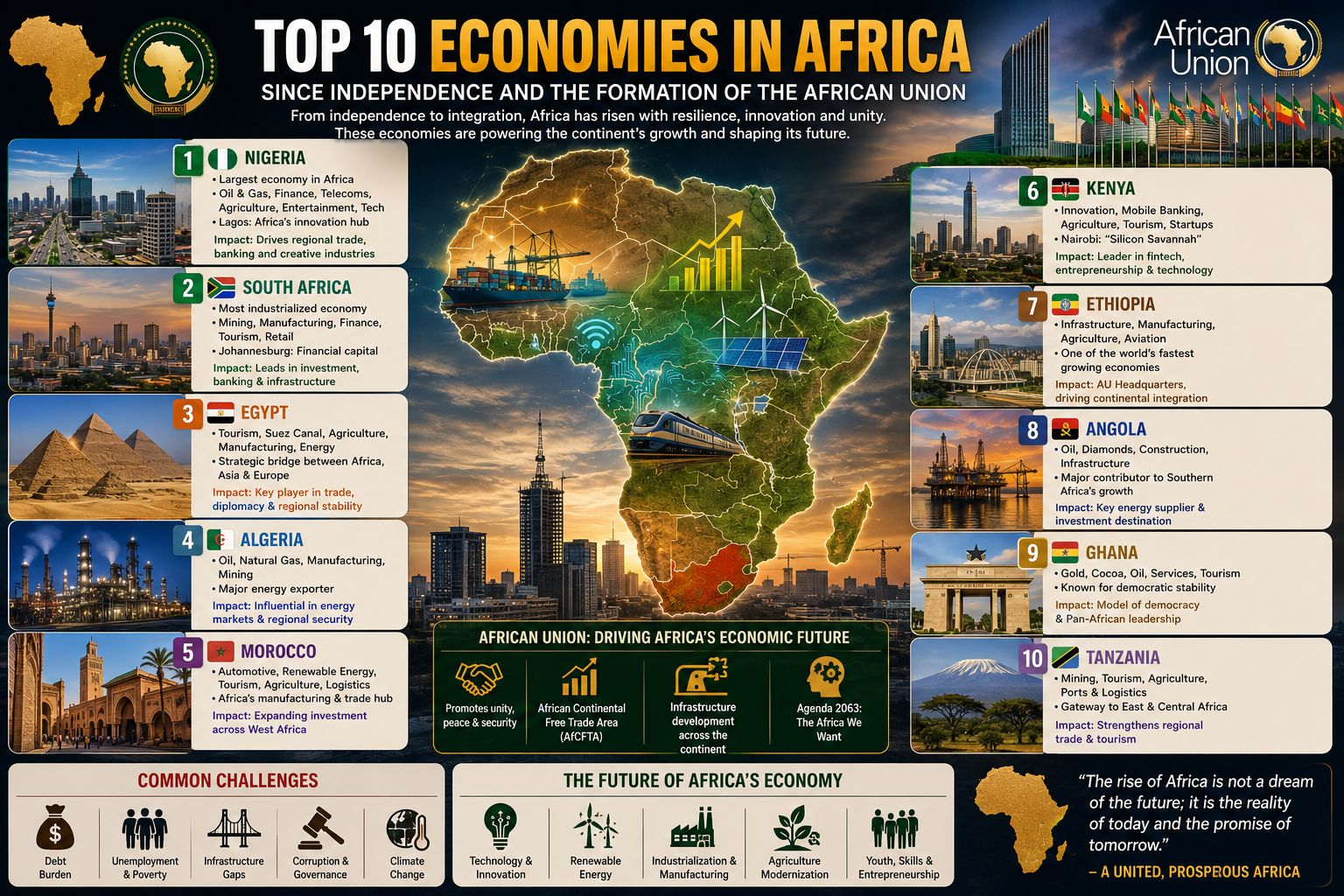
Africa’s economic journey since independence has been one of resilience, transformation, struggle, and innovation. Following the wave of independence movements from the 1950s through the 1990s, African nations inherited economies shaped by colonial extraction systems that primarily benefited European powers. Despite these challenges, several African countries emerged as economic leaders, driving industrialization, trade, finance, agriculture, energy production, technology, and continental integration.
The formation of the Organization of African Unity (OAU) in 1963 later transformed into the African Union (AU) in 2002 marked a major turning point in Africa’s pursuit of economic cooperation, political unity, and sustainable development.
Today, Africa is home to some of the fastest-growing economies in the world, powered by youthful populations, digital innovation, natural resources, infrastructure development, and regional trade integration under the African Continental Free Trade Area (AfCFTA).
This article explores the top 10 economies in Africa since independence, their historical growth, major industries, challenges, and their impact on the continent.
Africa’s Economic Evolution Since Independence
At independence, many African economies faced:
- Weak industrial bases
- High unemployment
- Colonial debt structures
- Dependence on raw material exports
- Limited infrastructure
- Political instability
However, through regional cooperation, Pan-African movements, and economic reforms, African countries gradually built stronger institutions and diversified their economies.
The African Union has played a major role in:
- Promoting continental trade
- Supporting infrastructure projects
- Encouraging peace and security
- Advancing Agenda 2063
- Establishing the AfCFTA
The AU’s long-term vision is to transform Africa into a globally competitive economic powerhouse.
1. Nigeria — Africa’s Giant Economy
Nigeria
Independence
1960 from Britain
Economic Strengths
Nigeria has long been regarded as Africa’s largest economy due to:
- Oil and gas production
- Banking and finance
- Telecommunications
- Entertainment industry (Nollywood)
- Agriculture
- Digital technology
Lagos has emerged as one of Africa’s biggest business and innovation hubs.
Historical Growth
Oil discoveries in the 1950s transformed Nigeria into a major energy producer. Despite political instability and economic fluctuations, Nigeria remains one of Africa’s most influential economies.
Impact on Africa
Nigeria contributes significantly to:
- African banking
- Creative industries
- Peacekeeping operations
- Regional trade through ECOWAS
Challenges
- Infrastructure gaps
- Youth unemployment
- Corruption
- Currency instability
2. South Africa — Africa’s Industrial Powerhouse
South Africa
Independence and Democracy
Union formed in 1910; democratic transition in 1994
Economic Strengths
South Africa possesses Africa’s most industrialized economy, driven by:
- Mining
- Manufacturing
- Finance
- Tourism
- Telecommunications
- Retail
Johannesburg remains the financial capital of Africa.
Historical Growth
The end of apartheid opened South Africa to global investment and expanded economic participation.
Impact on Africa
South Africa plays a leading role in:
- BRICS partnerships
- Continental banking
- Infrastructure investment
- Pan-African retail expansion
Challenges
- Inequality
- Energy shortages
- High unemployment
- Crime
3. Egypt — North Africa’s Economic Giant
Egypt
Independence
1922 from Britain
Economic Strengths
Egypt’s economy is powered by:
- Tourism
- Suez Canal revenues
- Agriculture
- Manufacturing
- Energy
- Construction
Historical Growth
Egypt has remained one of Africa’s most strategic economies due to its geographic position connecting Africa, Europe, and Asia.
Impact on Africa
Egypt contributes significantly to:
- Continental diplomacy
- Infrastructure development
- Energy cooperation
- Trade routes
Challenges
- Population pressure
- Inflation
- Water security concerns
4. Algeria — Energy and Industrial Economy
Algeria
Independence
1962 from France
Economic Strengths
Algeria’s economy is heavily driven by:
- Oil exports
- Natural gas
- Manufacturing
- Mining
Historical Growth
Following a brutal liberation struggle, Algeria invested heavily in state-led industrialization and social development.
Impact on Africa
Algeria remains influential in:
- Energy markets
- African diplomacy
- Regional security
Challenges
- Economic diversification
- Youth unemployment
- Dependence on hydrocarbons
5. Morocco — Africa’s Manufacturing and Trade Hub
Morocco
Independence
1956 from France and Spain
Economic Strengths
Morocco has developed strong sectors in:
- Automotive manufacturing
- Renewable energy
- Tourism
- Agriculture
- Logistics
Historical Growth
The country invested aggressively in infrastructure, ports, and industrial parks.
Impact on Africa
Morocco has expanded investment throughout West Africa and strengthened African trade connectivity.
Challenges
- Rural poverty
- Water scarcity
- Youth employment
6. Kenya — East Africa’s Innovation Economy
Kenya
Independence
1963 from Britain
Economic Strengths
Kenya is recognized for:
- Mobile banking innovation
- Agriculture
- Tourism
- Technology startups
- Regional trade
Nairobi is often called the “Silicon Savannah.”
Historical Growth
Kenya’s digital economy grew rapidly with innovations like M-Pesa revolutionizing mobile payments.
Impact on Africa
Kenya has become a leader in:
- Financial technology
- Regional logistics
- Entrepreneurship
Challenges
- Public debt
- Political tensions
- Urban inequality
7. Ethiopia — Africa’s Infrastructure Growth Story
Ethiopia
Historical Background
Africa’s oldest independent nation
Economic Strengths
Ethiopia expanded rapidly through:
- Infrastructure development
- Manufacturing
- Agriculture
- Aviation
Historical Growth
For years Ethiopia was among the fastest-growing economies globally, investing heavily in roads, railways, and industrial parks.
Impact on Africa
Ethiopia hosts the headquarters of the African Union in Addis Ababa, symbolizing African unity and diplomacy.
Challenges
- Internal conflict
- Inflation
- Debt pressures
8. Angola — Oil Wealth and Reconstruction
Angola
Independence
1975 from Portugal
Economic Strengths
Angola’s economy depends largely on:
- Oil production
- Diamonds
- Construction
- Infrastructure rebuilding
Historical Growth
After decades of civil war, Angola underwent major reconstruction fueled by oil revenues.
Impact on Africa
Angola became an important energy supplier and investment destination in Southern Africa.
Challenges
- Economic inequality
- Corruption
- Dependence on oil exports
9. Ghana — Democratic Stability and Economic Reform
Ghana
Independence
1957 from Britain
Economic Strengths
Ghana’s economy is driven by:
- Gold
- Cocoa
- Oil
- Services
- Tourism
Historical Growth
Under Kwame Nkrumah, Ghana became a symbol of African independence and Pan-Africanism.
Impact on Africa
Ghana is respected for:
- Democratic governance
- Peaceful transitions
- Pan-African leadership
Challenges
- Currency volatility
- Public debt
- Youth unemployment
10. Tanzania — Regional Trade and Natural Resources
Tanzania
Independence
1961 from Britain
Economic Strengths
Tanzania’s economy includes:
- Mining
- Tourism
- Agriculture
- Ports and logistics
Historical Growth
The country maintained relative political stability and invested in regional integration.
Impact on Africa
Tanzania plays a major role in:
- East African trade
- Tourism
- Regional diplomacy
Challenges
- Infrastructure development
- Poverty reduction
- Industrial expansion
The Role of the African Union in Economic Development
The African Union has become central to Africa’s economic future through:
- Agenda 2063
- African Continental Free Trade Area (AfCFTA)
- Infrastructure development projects
- Regional integration
- Peace and security cooperation
The AfCFTA is expected to become the largest free trade area in the world by number of participating countries.
Its goals include:
- Increasing intra-African trade
- Reducing dependency on foreign imports
- Boosting industrialization
- Creating jobs for African youth
Challenges Facing African Economies
Despite significant progress, African economies still face:
- Debt burdens
- Climate change
- Political instability
- Corruption
- Infrastructure deficits
- Global economic inequality
However, Africa’s youthful population and digital transformation present enormous opportunities for future growth.
The Future of Africa’s Economy
Africa’s future economic growth is expected to be driven by:
- Technology and innovation
- Renewable energy
- Creative industries
- Manufacturing
- Agriculture modernization
- Continental trade integration
Young entrepreneurs, startups, and creative industries are already reshaping Africa’s global image and economic influence.
Since independence and the formation of the African Union, Africa has made remarkable economic progress despite historical challenges. The continent’s leading economies have become engines of innovation, trade, culture, and diplomacy.
As Africa moves toward Agenda 2063, the dream of a united, industrialized, and economically independent continent continues to inspire millions across the globe.
The rise of Africa is no longer a future prediction it is already unfolding.