Africa is the cradle of humanity, home to ancient civilizations, powerful kingdoms, liberation movements, and some of the world’s richest cultural traditions. Yet for decades, African history was often told through colonial perspectives that overlooked African voices and achievements. Today, a new generation of scholars, writers, and historians is reclaiming the narrative and presenting Africa through African eyes.
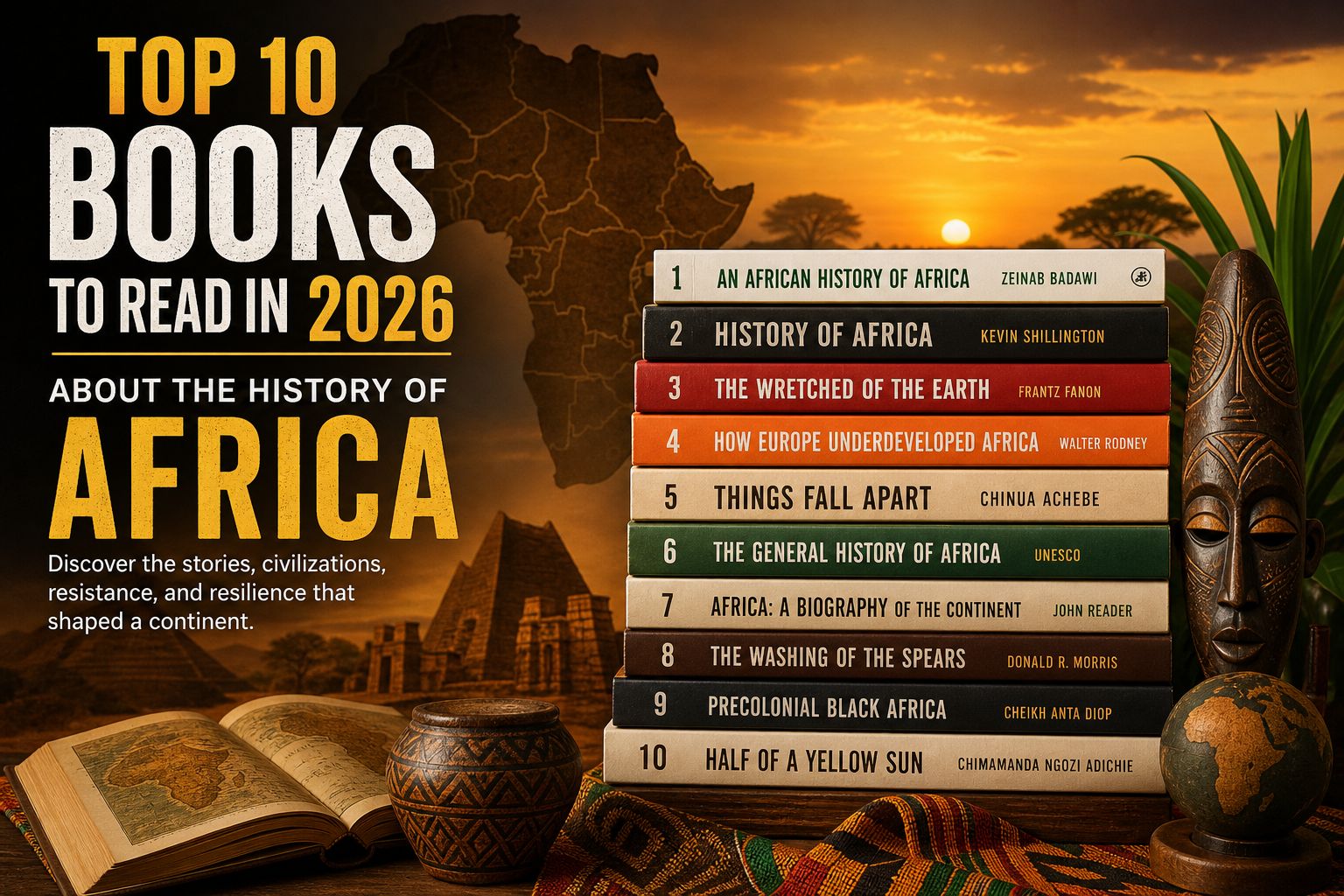
Whether you are a student, researcher, broadcaster, activist, entrepreneur, or simply passionate about Pan-Africanism, these books offer essential knowledge about the continent’s past, present, and future. Here are the top 10 books to read in 2026 about the history of Africa including reviews from readers and scholars around the world.
1. An African History of Africa — Zeinab Badawi
This groundbreaking book has quickly become one of the most celebrated African history books in recent years. Renowned journalist and broadcaster Zeinab Badawi travels across the continent to uncover Africa’s story from African perspectives.
The book explores ancient Egypt, Nubia, Mali, Ethiopia, Great Zimbabwe, resistance movements, and post-colonial Africa while challenging long-standing Western interpretations of African history.
Review Highlights
Critics have praised the book for being “accessible, engaging, and deeply researched.” Many readers appreciate how Badawi combines storytelling with historical scholarship, making African history easier to understand for modern audiences.
One reviewer described it as:
“A powerful correction to centuries of distorted African narratives.”
2. History of Africa — Kevin Shillington
If you are looking for one complete introduction to African history, this is one of the best starting points. Kevin Shillington presents thousands of years of African civilization in a detailed but readable format.
The book covers:
- Ancient African kingdoms
- Trade routes and empires
- Colonial conquest
- Independence movements
- Modern African politics and economics
Review Highlights
Students and educators frequently recommend this book because of its balanced approach and wide historical coverage.
Readers often say:
“It’s like an encyclopedia of African history written in a way ordinary people can understand.”
3. The Wretched of the Earth — Frantz Fanon
Few books have influenced liberation movements globally like this classic by Frantz Fanon. Written during the anti-colonial struggles of the 20th century, the book examines the psychological and political effects of colonialism.
Fanon discusses:
- Violence and resistance
- Identity and oppression
- Mental liberation
- The struggle for dignity
Review Highlights
The book remains influential among activists, scholars, and Pan-African thinkers.
A common review states:
“Fanon explains colonialism not only as political domination, but as psychological warfare.”
4. How Europe Underdeveloped Africa — Walter Rodney
This masterpiece by Guyanese historian Walter Rodney is essential reading for understanding Africa’s economic challenges. Rodney explains how slavery, colonialism, and exploitation disrupted Africa’s development for centuries.
The book critically examines:
- The slave trade
- Colonial economics
- Resource extraction
- Dependency systems
Review Highlights
Many readers describe the book as “eye-opening” and “transformative.”
One review notes:
“After reading Rodney, you see African poverty through a completely different lens.”
5. Things Fall Apart — Chinua Achebe
Although it is a novel, Things Fall Apart is one of the most important books ever written about African society before colonialism. Chinua Achebe tells the story of Okonkwo, a respected Igbo leader whose world changes dramatically after European missionaries arrive.
Review Highlights
The novel is praised for humanizing African societies that colonial literature once stereotyped.
Readers often say:
“Achebe restored African dignity in literature.”
6. The General History of Africa — UNESCO
This monumental series was developed by African scholars to present Africa’s history from an African-centered perspective. It spans multiple volumes and covers everything from prehistoric Africa to modern independence movements.
Topics include:
- Ancient civilizations
- African philosophy
- Trade and migration
- Resistance against colonialism
Review Highlights
Scholars regard the series as one of the most important academic projects on African history ever undertaken.
Many researchers describe it as:
“The foundation of serious African historical studies.”
7. Africa: A Biography of the Continent — John Reader
This fascinating work combines geography, archaeology, anthropology, and history to explain how Africa shaped human civilization.
The book explores:
- Human origins
- Climate and geography
- Ancient migration
- Civilizational growth
Review Highlights
Readers enjoy the book’s storytelling style and scientific insights.
One reviewer commented:
“It reads like an adventure through millions of years of African history.”
8. The Washing of the Spears — Donald R. Morris
This classic focuses on the rise of the Zulu Kingdom and the Anglo-Zulu War of 1879. It explores the military genius of King Shaka Zulu and the resistance of African kingdoms against colonial forces.
Review Highlights
History enthusiasts praise the detailed battle descriptions and cultural insights.
A reviewer wrote:
“One of the greatest military histories ever written about Southern Africa.”
9. Precolonial Black Africa — Cheikh Anta Diop
Cheikh Anta Diop challenged Eurocentric interpretations of African civilization and emphasized Africa’s intellectual and scientific contributions to humanity.
The book explores:
- African civilizations
- Linguistics and culture
- Ancient Egypt’s African identity
- Traditional governance systems
Review Highlights
The book is widely respected among Pan-African scholars.
Readers frequently say:
“Diop changed the way Africa sees itself.”
10. Half of a Yellow Sun — Chimamanda Ngozi Adichie
This award-winning historical novel focuses on the Nigerian-Biafran War and its devastating human impact. Through powerful storytelling, Adichie brings African post-independence struggles to life.
Review Highlights
The novel is celebrated for combining emotional storytelling with historical education.
A popular reader review states:
“It teaches history through unforgettable human experiences.”
Why These Books Matter in 2026
Africa is entering a new era of global influence through:
- Youth leadership
- Digital innovation
- Cultural exports
- Economic integration
- Pan-African cooperation
To understand where Africa is going, we must understand where Africa has been.
These books help readers:
- Reclaim African identity
- Understand colonialism and liberation
- Appreciate African civilizations
- Explore Pan-African thought
- Learn from African resistance movements
Final Thoughts
African history is not a story of darkness or dependency. It is a story of kingdoms, philosophy, science, music, spirituality, resistance, creativity, and resilience.
The more Africans tell their own stories, the more the world will understand the true greatness of the continent.
As African intellectual movements continue to grow in 2026, these books remain essential reading for anyone passionate about the future of Africa and its people.
For broadcasters, educators, journalists, students, and cultural activists, these works provide both knowledge and inspiration for building a more conscious and united Africa.