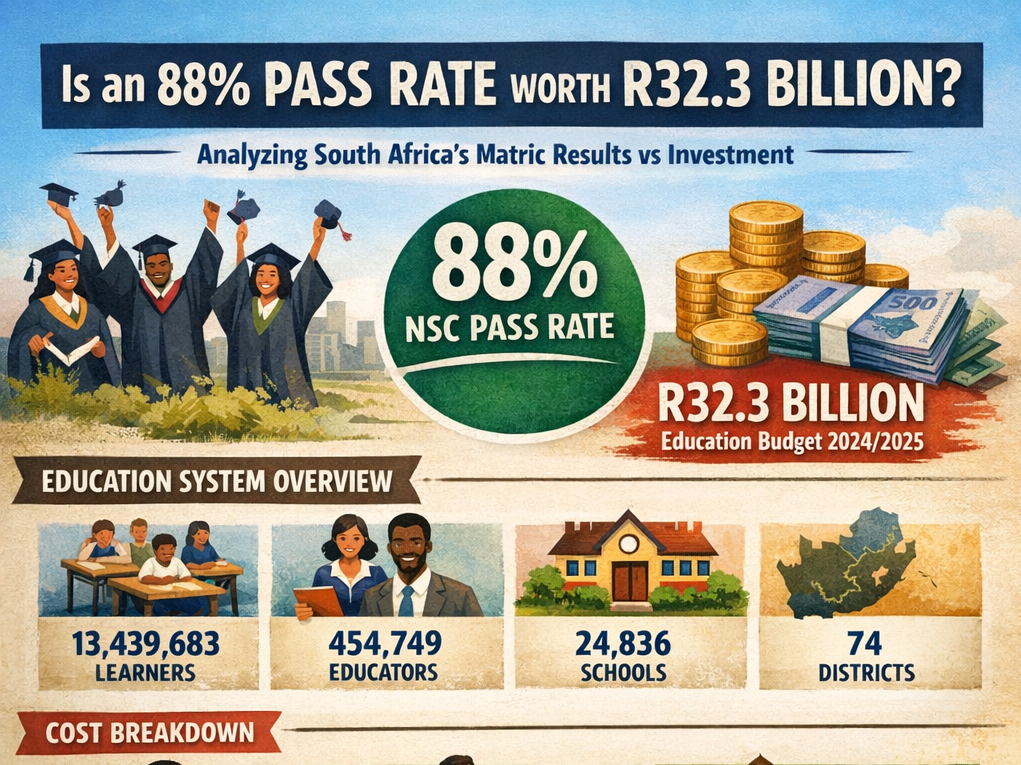
Evaluating South Africa’s Matric Pass Rate Against Education Investment. South Africa’s National Senior Certificate (NSC) exam achieved an 88% pass rate for the 2025 curriculum, celebrated as a sign of educational recovery. However, this raises an important question: is the R32.3 billion investment in education justified by these results?
South Africa’s 2025 National Senior Certificate (NSC) examination pass rate of 88% has been widely welcomed as a sign of resilience and recovery in the basic education system. But beyond the headline figure lies a critical public-interest question: does the output justify the input? In other words, is the R32.3 billion spent in the 2024/2025 curriculum year reflective of the results achieved?
To answer this, the pass rate must be analysed against the scale and cost of the education system it represents.
The System at a Glance
South Africa’s basic education landscape in the 2024/2025 curriculum year comprised:
- 13,439,683 learners in ordinary public and independent schools
- 454,749 educators
- 24,836 schools
- 74 education districts across 9 provinces
- R32.3 billion spent in the curriculum year under review
This is one of the largest education systems on the African continent, operating across vast geographic, economic, and social inequalities.
Understanding the 88%
The 88% NSC pass rate refers specifically to the matric cohort, not to the entire learner population of over 13.4 million. This distinction is crucial. The pass rate measures performance at the exit point of schooling, after 12 years of cumulative investment, teaching, and assessment.
As an outcome indicator, the 88% suggests improved throughput, better learner support, and more effective examination preparation compared to previous decades when pass rates hovered far lower.
Cost vs Outcome: The Numbers
When the R32.3 billion is viewed in proportional terms, several insights emerge:
- Cost per learner:
Approximately R2,400 per learner per year (R32.3bn ÷ 13.44m learners) - Cost per educator:
Roughly R71,000 per educator per year, noting that this figure reflects curriculum-related expenditure, not full remuneration costs - Cost per school:
About R1.3 million per school annually
By global standards, this level of per-learner spending is modest, especially when compared to middle and high-income countries. Yet South Africa carries a far heavier burden of historical inequality, infrastructure backlogs, language diversity, and socio-economic challenges.
Is the Spending Reflective of the Results?
From a purely numerical standpoint, an 88% pass rate on relatively low per-learner expenditure suggests reasonable efficiency. The system is producing a high matric pass rate without excessive spending per learner.
However, pass rate alone cannot be the sole measure of value for money.
Key concerns remain:
- Quality vs quantity: How many of the 88% achieved bachelor-level passes that enable university access?
- Dropout rates: How many learners who entered Grade 1 actually reached matric?
- Inequality of outcomes: Are rural and township schools benefiting equally from the investment?
- Post-school readiness: Does the system adequately prepare learners for higher education, skills training, or the labour market?
Without strong performance in mathematics, science, literacy, and critical thinking, a high pass rate risks becoming a statistical success rather than a developmental one.
The Bigger Picture
Education is a long-term investment with returns measured not only in pass rates, but in economic participation, reduced inequality, social cohesion, and national productivity. In this context, the R32.3 billion spend has delivered a credible but incomplete return.
The 88% pass rate indicates that the system is working, but not yet working optimally.
So, is the money spent reflective of the results?
Partially, yes.
The 88% NSC pass rate demonstrates that South Africa is achieving solid outcomes with limited resources across a massive and complex education system. However, the true test of value for money lies beyond the pass rate, in learner retention, quality of passes, and the ability of graduates to succeed beyond the school gates.
For future curriculum years, the challenge is not merely to maintain high pass rates, but to ensure that every rand spent translates into deeper learning, equitable outcomes, and real socio-economic mobility. Only then will the output truly match and justify the input.